
ChatGPT shows local business ratings from two different sources and a small visual tell reveals which one you are looking at every single time.
Pull up a ChatGPT local recommendation and look closely at the little star rating on each business card. Where is that number coming from? In our August 2026 study, which asked "who is the best {service} in {city}" across 216 US markets and recorded the ChatGPT web app's own responses, we validated every displayed card against same-day Yelp and Google snapshots to answer exactly that.
The result: ChatGPT runs on two reputation systems at once, and it tells you which one you are looking at through a visual tell that turned out to be nearly perfect.
ChatGPT pulls ratings from both Google and Yelp
Across the first wave of the study, 215 markets produced 975 displayed business cards. Of the 799 cards we could resolve to a rating source, 139, or 17.4%, carried Yelp ratings (CI 13.6% to 21.8%). The rest resolved to Google. A further 150 of 975 cards showed no rating at all (15.4%), 24 were unresolvable (2.5%), and 2 matched both sources exactly (0.2%).
So Google is the default reputation feed, but roughly one card in six speaks Yelp. The full validation method, including the hand audit behind it, is on the study page at how ChatGPT picks a local business.
The Yelp logo predicted the rating source every time
Here is the tell. Some cards render with a small Yelp logo. Some render with a Request a Quote button. Some render bare. Those design choices turned out to be a nearly deterministic map of where the rating came from:
- Card shows a Yelp logo: the rating validated against Yelp 138 of 138 times (100.0%).
- Card shows only a Request a Quote button: the rating validated against Google 114 of 114 times (100.0%).
- Card shows no logo and no button: Google 546 of 547 times (99.8%).
That means anyone can audit their own market in about a minute. Ask ChatGPT the buyer question for your category and city, find your card, and read the furniture. Logo means your Yelp profile just introduced you. Bare card or quote button means Google did.
The Request a Quote button has its own industry pattern, showing up on 49.5% of roofing cards (47 of 95) and 46.3% of real estate cards (25 of 54), while never appearing for chiropractors, dentists, med spas, personal injury lawyers, or therapists in our data.
Plumbers get Yelp while therapists get Google
The 17.4% average hides a wide industry spread, which is why your neighbor in a different trade can have a totally different experience of AI search.
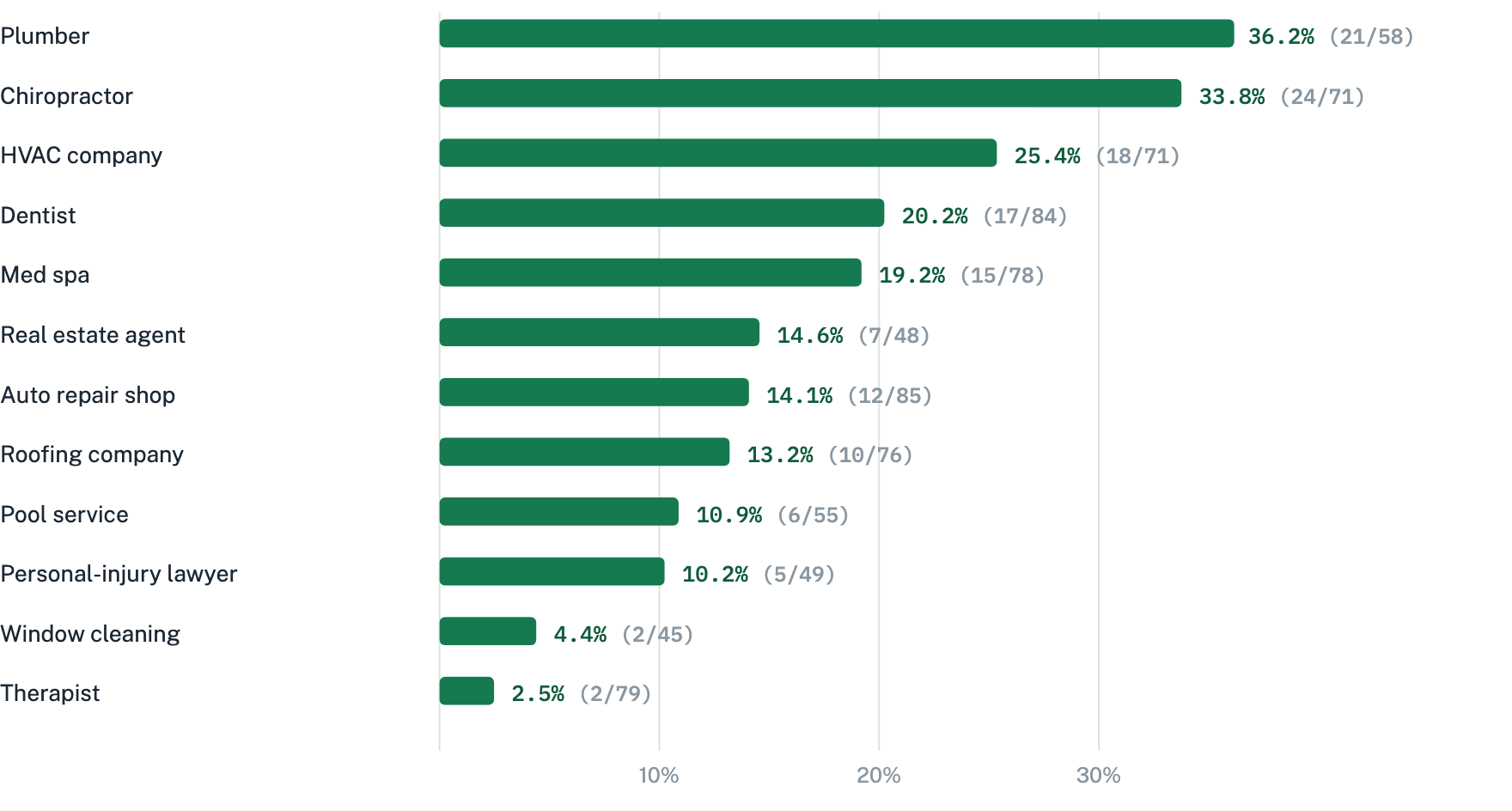
Yelp share of resolved cards by vertical (first wave, 215 markets): plumbers 21 of 58 (36.2%), chiropractors 24 of 71 (33.8%), HVAC 18 of 71 (25.4%), dentists 17 of 84 (20.2%), med spas 15 of 78 (19.2%), down to window cleaning 2 of 45 (4.4%) and therapists 2 of 79 (2.5%).
Home services and health-adjacent categories leaned hardest on Yelp. Therapists almost never saw it. Geography stacked on top of that: the three highest Yelp-share cities in the study were Los Angeles at 42.3% (22 of 52), Long Beach at 39.1% (18 of 46), and Cerritos at 37.2% (16 of 43), all coastal Southern California, where Yelp's consumer footprint has always run deep. Market size mattered too: major metros ran at 24.9% Yelp share (48 of 193 resolved cards) and suburbs at 25.8% (46 of 178), while small cities sat at just 8.4% (19 of 225).
If you are a plumber in Southern California, your Yelp profile is close to a coin-flip candidate for being the face ChatGPT gives you.
ChatGPT flipped the rating source on the same business
The two-source system is not even stable per business. Among businesses recommended in both waves of the study, the displayed rating source flipped between Google and Yelp for 75 of 469, or 16.0%, within a week.
Same business, same question, days apart, different reputation system on display. One buyer meets your 4.9 on Google. The next meets whatever your Yelp profile says, including the review you never responded to in 2023. This connects to the churn finding from the first post in this series: the answer is rebuilt per ask, and that rebuild extends all the way down to which review profile gets quoted.
Both profiles now front your business
The takeaway is unusually clean for this space. You do not get to choose which reputation ChatGPT shows, so both need to be ready for the spotlight:
- Claim and complete your Yelp profile even if Yelp has never sent you a customer directly. In our data its job has changed from referral source to rating supplier.
- Keep the basics identical across both: name, categories, hours, service area.
- Keep earning honest reviews in both places rather than treating Google as the only scoreboard.
None of this is new work. It is the standard reputation work described in how to get recommended by ChatGPT, with a sharper reason attached: roughly one card in six, and one in three in some industries, is wearing Yelp's numbers.
The questions owners ask most about where ChatGPT gets its business ratings, answered from the study data.
Ready to know which profile ChatGPT shows for you?
The audit takes minutes and the fix is ordinary profile and review work, just aimed at two targets instead of one. Spearleaf checks this as part of every AI search engagement: which source fronts your business in your market, what that profile currently says, and what it will take to make both versions of your reputation worth recommending. If you want that picture for your business, reach out through our contact page and we will pull it together with you.
This article was written by Joshua Albanese, founder of Spearleaf, a local SEO and marketing agency based in Fort Myers, Florida. Joshua has built six businesses from zero using organic search and content, and he leads Spearleaf's SEO, AI search, and local strategy for service businesses across the U.S.
Frequently asked questions
Where does ChatGPT get the business ratings it displays?
From two places. In our August 2026 study of 975 recommendation cards across 215 US markets, most resolved cards carried Google ratings, while 17.4% carried Yelp ratings (139 of 799 cards we could resolve to a source). We validated every displayed card against same-day Yelp and Google snapshots to make those calls. Which source appears depends heavily on your industry and your city, so the practical answer is that both profiles feed ChatGPT and both need to be in shape.
How can I tell if ChatGPT is showing my Google or my Yelp rating?
Look at the card. In our study a visible Yelp logo meant the rating validated against Yelp 138 out of 138 times, and a card with no logo and no button matched Google 546 of 547 times (99.8%). A card showing only a Request a Quote button matched Google 114 out of 114 times. The card design itself is a reliable tell, so a quick look at how your business renders in an answer tells you which profile is doing the talking.
Does Yelp still matter for AI search if most ratings come from Google?
In several industries it matters a lot. Yelp supplied the rating on 36.2% of resolved plumber cards (21 of 58) and 33.8% of chiropractor cards (24 of 71) in our study, and in coastal Southern California cities the Yelp share ran as high as 42.3% (Los Angeles, 22 of 52). If you are in home services or health-adjacent categories, or in a Yelp-strong metro, an out-of-date Yelp profile can be the version of your reputation ChatGPT shows. A dormant profile is worth an afternoon of cleanup.
Can ChatGPT switch which rating source it shows for my business?
Yes. Among businesses that ChatGPT recommended in both waves of our study, the displayed rating source flipped between Google and Yelp for 16.0% of them (75 of 469) within a week. The same business can be introduced to one buyer through its Google reviews and to the next through its Yelp reviews. That is the strongest practical argument for keeping both profiles accurate and well reviewed rather than picking a favorite.
Not sure whether ChatGPT is showing your Google rating or your Yelp rating in your market? Let's check both profiles and get them ready.
Learn more →