
A one-star review isn't the end of the world. Here's exactly what to say, with six replies you can copy, adjust, and post today.
The best response to a negative review is a calm, specific, public reply that owns your part, offers to make it right, and takes the details offline, all in three or four sentences. You're not writing to win the argument with one upset person. You're writing for the next hundred people who read it, and it's a core piece of the reputation management work I do for local businesses every week.

I'm Joshua Albanese, and I've walked a lot of service-business owners through the gut-punch of a bad review. The good news is steady: a review you handle well often does more for you than the five-star ones nobody reads twice. Below are the four rules behind every good reply, then six templates you can copy, adjust to your voice, and post today.
Should you respond to negative reviews?
Yes, respond to almost every negative review, because the reply is public proof for future customers that you listen and make things right. Google itself encourages owners to respond to reviews, and it says replying builds trust and can improve engagement with your profile. Read that as your instruction: don't leave a complaint standing alone as the only version of the story.
Here's the shift that helps most owners. Stop picturing the angry reviewer as your audience. Your real audience is the careful shopper reading your profile weeks later, deciding between you and a competitor. That person isn't scared off by one bad review among many good ones. They're scared off by silence, or by an owner who lost their temper in public.
A steady reply flips the whole thing. It tells that shopper you're the kind of business that shows up when something goes wrong, which is exactly what they're worried about. One good response can outweigh the complaint that triggered it.
The four rules behind every good reply
Before the templates, internalize these four. Get them right and you can write a good reply to anything, even the reviews that aren't in the list below.
- Stay calm and keep it short. Three to four sentences. The longer and more defensive you get, the guiltier you look, even when you're right.
- Thank them and acknowledge the specific issue. Name what they said. Generic replies read like a copy-paste machine, which is the opposite of caring.
- Take it offline. Give a name, a direct email, or a phone number and invite them to reach you. You want the resolution to happen in private, not in a public back-and-forth.
- Never share private details. Don't confirm health information, case specifics, or anything about their account in public. In medical, legal, and financial work, that can cross a legal line, so treat it as a hard boundary.
One more rule that sits above all of them: never gate or buy your way out. Don't offer money in public to delete a review, don't ask only happy customers to post, and never buy fake reviews to bury a real one. Those tactics violate Google's and the FTC's rules and can wipe your reviews entirely. The whole point is to earn trust honestly.
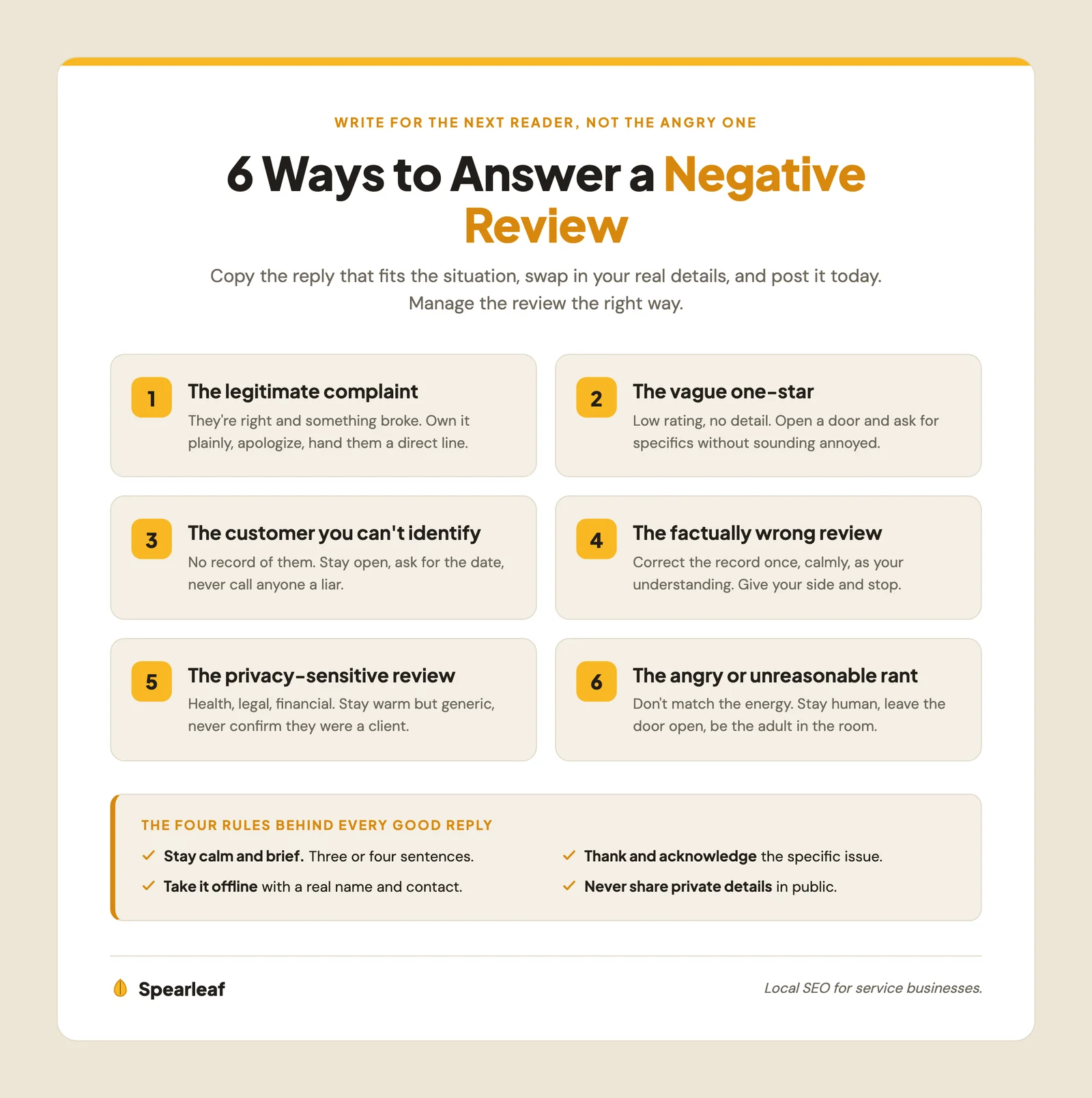
6 templates for responding to negative reviews
Copy the one that fits, swap in the brackets for your real details, and match it to how you actually talk. These are starting points, not scripts to paste word for word. The scenario matters more than the exact wording, so pick by what the reviewer is actually upset about.
Template 1: The legitimate complaint you can fix
Use this when they're right and something genuinely went wrong. This is the most common case, and the easiest to win, because owning a real mistake reads as strength.
Hi [Name], thank you for telling me about this, and I'm sorry we dropped the ball on [specific issue]. That's not the experience we want anyone to have, and I'd like to make it right. Please reach me directly at [email or phone] so I can fix this for you. Thanks, [Your name], owner.
The move here is speed and ownership. No "if" or "but." You name the problem they named, apologize plainly, and hand them a direct line.
Template 2: The vague one-star with no detail
Use this when someone leaves a low rating with little or no explanation. You can't fix what you can't see, so your job is to open a door without sounding annoyed.
Hi [Name], I'm sorry to see you had a disappointing experience, and I'd genuinely like to understand what happened. I don't have enough detail here to make it right, but I want to. Could you email me at [email] with a few specifics? I read every one myself. Thanks, [Your name].
Notice you're not demanding proof or implying they're lying. You're showing the next reader that you welcome the feedback and you're not hiding.
Template 3: The customer you can't identify
Use this when you have no record of the person and suspect a mixed-up business, or you're just not sure they're yours. Stay open, don't accuse.
Hi [Name], thank you for the feedback. I want to look into this, but I'm not finding a record of your visit on our end, and I don't want to assume. Would you email me at [email] with the date and any details? If there's a mix-up I'll help you sort it out either way. Thanks, [Your name].
This protects you against fake or misplaced reviews without ever calling the person a liar in public, which always backfires.
Template 4: The factually wrong or exaggerated review
Use this when the review misstates what happened. You can correct the record, once, calmly, without arguing every point. Give your side and stop.
Hi [Name], I appreciate you taking the time, though my understanding of what happened is a little different. Our records show [one plain, factual correction], and I'm sorry it still left you unhappy. I'd like to talk it through directly at [phone or email] and see how I can help. Thanks, [Your name].
One correction, stated as your understanding, not a takedown. The reader can tell the difference between a business that's defensive and one that's simply setting the facts straight.
Template 5: The privacy-sensitive review (health, legal, financial)
Use this in any field where confirming someone's details in public is a problem. Here your restraint is the message. You cannot acknowledge they were a patient or client.
Thank you for your feedback. Out of respect for privacy, we don't discuss individual experiences in a public forum, but we take every concern seriously and want to help. Please contact our office directly at [phone or email] and ask for [Name], and we'll do everything we can to address this. Sincerely, [Practice name].
Keep it warm but generic. You never say "your appointment" or "your case." You invite them to a private channel where you can actually talk.
Template 6: The angry or unreasonable rant
Use this when the review is hostile, personal, or clearly written in a rage. Do not match the energy. Your calm is the whole point, and every future reader will notice who kept their composure.
Hi [Name], I'm sorry you're this frustrated, and I hear you. I'd still like the chance to understand your experience and see what I can do to help. If you're open to it, please reach me directly at [email or phone]. Thanks, [Your name], owner.
You don't defend, and you don't scold. You stay human and leave the door open. A composed reply next to a furious review makes you look like the adult in the room, every time.
What if the review is fake or breaks the rules?
If a review genuinely violates Google's policies, you can flag it for removal, but disliking a review is not grounds. Google removes reviews for things like spam, hate speech, conflicts of interest, or content from someone with no real experience of your business. You report it through your Google Business Profile and wait, with no guarantee of the outcome.
Two honest cautions here. Removal is slow and often unsuccessful, so don't pin your hopes on it. And most unfair reviews aren't actually against the rules, they're just harsh opinions, which Google won't touch. For those, your public reply is the real remedy.
While a flag is pending, still reply. A calm, professional response under a false review tells every reader you're handling it like a grown-up, which does more for you than the takedown might. My guide on why your business might not be showing up on Google covers the broader profile signals that reviews feed into.
The best defense is more reviews coming in
The owners who lose sleep over one bad review are almost always the ones with only a handful of reviews total. When you have a steady stream coming in, a single one-star drops from a crisis to a blip. It's simple math, and it's the most durable fix there is.
So build the habit alongside the replies. Ask happy customers right after a good experience, make it a one-tap link, and respond to the good ones too so the profile looks alive. Do that and the occasional negative review lands softly, cushioned by a dozen recent fives. My walkthrough on getting more Google reviews the right way lays out the whole system, with no gating and no shortcuts.
None of this requires tricks. Reply like a decent person, fix what you can, keep the private stuff private, and keep the honest reviews flowing. Do those things longer than your competitors do and your reputation stops being something that happens to you and becomes something you own.
The questions I hear most from owners staring at a review they don't know how to answer.
Ready to stop losing sleep over your reviews?
Responding to negative reviews well comes down to a repeatable habit: stay calm, acknowledge the real issue, take it offline, protect privacy, and keep earning fresh reviews so no single one carries too much weight. Do it consistently and your profile starts working for you instead of against you. If you'd rather have a team build the review-earning system and coach you through the hard replies, our reputation management program does exactly that, ethically, with no gating and no fake reviews.
This article was written by Joshua Albanese, founder of Spearleaf, a local SEO and marketing agency based in Fort Myers, Florida. Joshua has built six businesses from zero using organic search and content, and he has coached local service owners across the U.S. through responding to reviews and building a reputation that earns the next customer.
Frequently asked questions
Should you respond to negative reviews at all?
Yes, and almost always. A calm, specific reply is written for every future reader who scrolls past that review, not really for the angry reviewer. It shows a real business stood up, listened, and offered to make it right. Skipping the reply lets one unhappy voice be the only story a shopper hears. Most owners who start replying to every review, good and bad, tell me the tone of their whole profile changes within a couple of months.
How long should you wait to respond to a bad review?
Long enough to cool down, short enough to still matter. I tell owners to sleep on anything that made their stomach drop, then reply within a day or two. Waiting a few hours protects you from firing off something defensive you can't take back. Waiting a week signals you either didn't notice or didn't care. If you're still angry when you sit down to write, you're not ready. Draft it, save it, and read it again in the morning.
Can you get a fake or unfair review removed from Google?
Sometimes, but only if it genuinely breaks the rules. Google will remove reviews that violate its policies, like spam, hate speech, conflicts of interest, or content with no real experience behind it. You flag it through your Google Business Profile and wait, and there's no guarantee. Simply disliking a review, or disagreeing with it, is not grounds for removal. For the far more common unfair-but-allowed review, your best tool is a public reply that gives the real context.
What should you never do when responding to a negative review?
Never argue the facts line by line, never get sarcastic, and never share private details about the customer or their case. Publicly confirming someone was a client, or airing what happened at their visit, can violate their privacy and, in health or legal settings, the law. Don't offer money in public to make a review disappear, and never write or buy fake positive reviews to bury it. Every one of those moves reads worse to the next reader than the original complaint did.
Is it against the rules to ask customers to remove a review?
Asking politely isn't against Google's rules, but conditioning anything on it is. You can't offer a discount, a refund, or a gift in exchange for taking a review down or changing it, and you can't only ask happy customers to post while filtering out the unhappy ones. That practice, called review gating, violates Google's and the FTC's guidelines and can get your reviews wiped. The honest path is to fix the problem, reply well, and let the customer decide on their own.
Tired of one bad review setting the tone for your whole business? See how our reputation management program earns reviews and handles the hard ones.
Learn more →