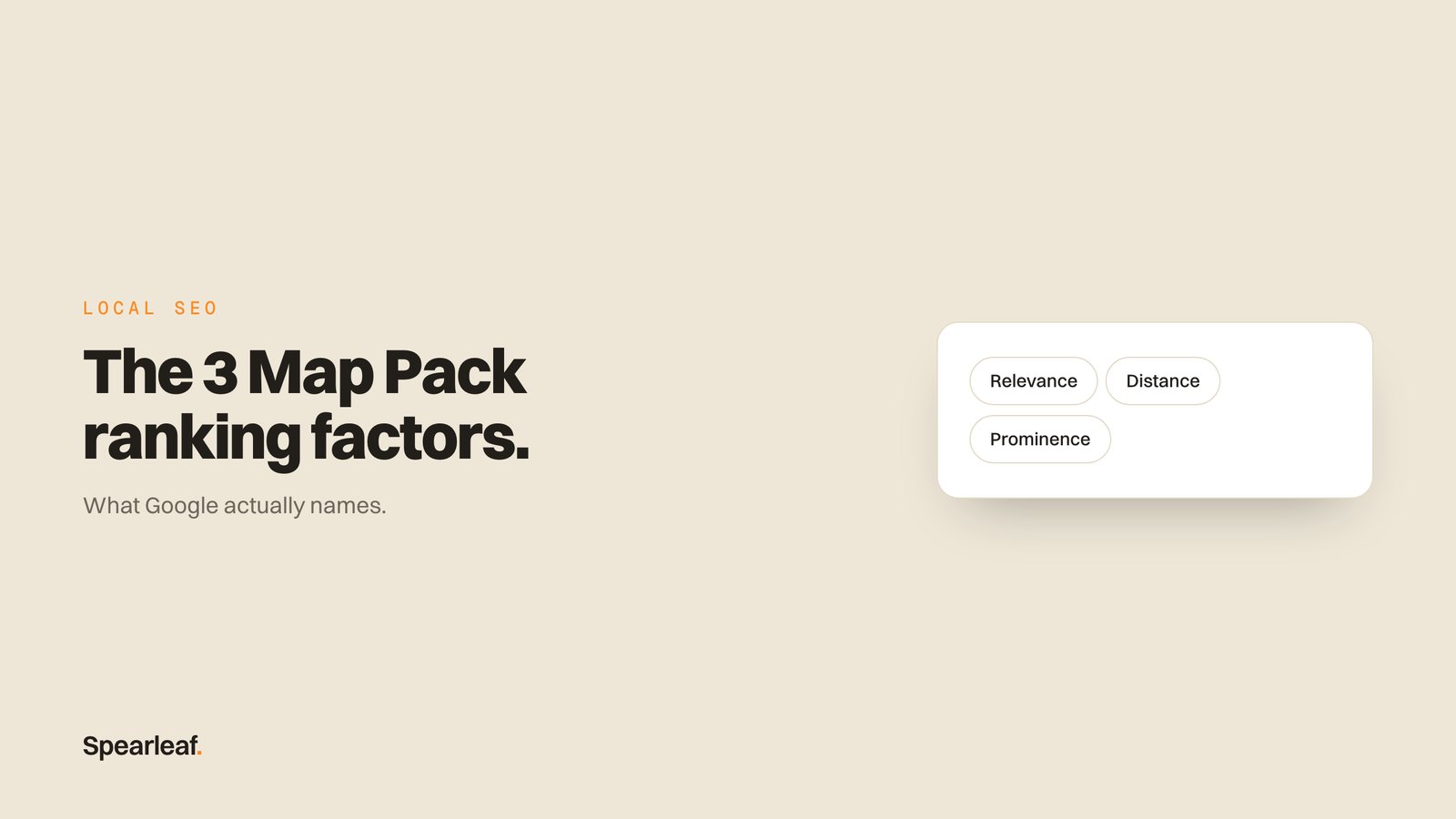
One small business owner put it plainly. "I searched my business on Google, and nothing showed up." That moment is a Map Pack problem. Google Business Profile optimization is the first lever to pull: your GBP is the asset Google scores all three local ranking factors through. Those three factors are relevance, distance, and prominence, the only ones Google officially names on its local-ranking help page.
What is the Google Map Pack, and what are its ranking factors?
Per Google's local-ranking help page, the Map Pack ranks businesses by three named factors: relevance, distance, and prominence. Build your GBP and website signals around those three and every other ranking action falls into place.
The Map Pack (also called the local 3-pack or local pack) is the block of three business listings above organic results. It's the surface where phone calls and in-person visits begin for most local service businesses. Every signal owners act on, from categories to review count, feeds one of Google's three factors.
One r/smallbusiness owner said it well. "What worked better for me was finding a local SEO guy who specializes in small businesses, not one of these big agencies that charge thousands."
The three factors Google actually names: relevance, distance, prominence
Google's local-ranking documentation defines all three factors. Each is one column in the pack's ranking calculation.
Relevance
Relevance measures how well your Business Profile matches what someone searched for. A med spa that lists "Botox" and "facial treatments" matches more searches than one with a generic "spa" category.
Distance
Distance measures how far each business is from the searcher's location. You can't move your building, but verifying your address and defining your service area correctly maps you to the right searches.
Prominence
Prominence measures how well-known your business is. Google draws from links to your website, your review count and score, and your overall web presence. Offline recognition as a well-known local institution can also factor in.
Source: Google Business Profile Help, support.google.com/business/answer/7091
How Google Business Profile rolls up under all three factors
Use your Google Business Profile as the anchor for all three factors. Per Google's local-ranking help page, GBP is the asset Google measures relevance, distance, and prominence through. Build each factor directly in your profile.
Under relevance, categories and business name tell Google what searches you match. Under distance, a verified address maps you to the right area. Under prominence, review count, star rating, photos and videos, and accurate business hours are the signals Google lists as improvement actions.
Keep owner access in your own hands. Avoid services that simulate clicks to "improve CTR" and don't buy reviews. One Thrive client lost their profile days after handing over access.
"Just 3 to 4 days after granting them access to our Google My Business account, our profile was suddenly suspended." (Thrive, Trustpilot)
Reviews: what Google says, what owners hear
Per Google's help page, two review signals sit under prominence: how many reviews you have, and whether those ratings are positive. Ask for reviews after a good experience, respond to every one, and monitor your star rating.
What Google does NOT name as a ranking signal: response rate, a ten-review threshold, or specific recency weight. Those are industry-survey interpretations. Google does list "Respond to reviews" as an improvement action, which is a best practice for your presence on Google, not a named prominence calculation input.
Backlinks, citations, and the on-page basics
Backlinks and your web presence
Google names "how many websites link to your business" as a direct prominence signal. Local backlinks from news sites, community directories, and industry associations are the practical version. A spammy mass-link scheme doesn't count here.
Citations and NAP consistency
A citation is a listing of your business NAP (name, address, phone) on Yelp, Facebook, and the BBB. Consistent NAP signals accuracy to Google. Inconsistent data, old phone numbers, wrong addresses, creates noise that works against your local ranking.
On-page signals
Your website's local content feeds relevance. Dedicated service pages and location pages that name what you do and where help Google understand the match. Title tags and LocalBusiness schema carry those local SEO signals back.
What about AI search: does ChatGPT rank the same way?
No, AI answer engines don't use Google's local-pack algorithm. Per Google's local-ranking documentation, the Map Pack runs on relevance, distance, and prominence, a local-only algorithm separate from AI-engine citation logic. Build the same underlying business signals and you move on both surfaces at once.
An r/smallbusiness owner summarized the shift this way. "Right now in SEO after introduction of Chatgpt, Google is ranking website which are having good brand mentions on Internet." That framing is roughly right.
AI answer engines like ChatGPT, Gemini, and Perplexity draw on verified GBP data, consistent NAP, real reviews, and authoritative links. Those are the same inputs that move the Map Pack. Spearleaf's AI search optimization work runs both surfaces in parallel.
How to actually rank in the Map Pack (the owner's working list)
Work through each step and you're directly building one of Google's three local ranking factors: relevance, distance, or prominence. These Google Map Pack ranking factors need consistent execution, not a longer checklist. An r/smallbusiness owner put it accurately: "SEO is a different ball game though. It takes so long to understand where you're doing something wrong or right, a lot of time passes by."
-
Claim and verify your Google Business Profile. An unverified profile sits outside the ranking pool. Verification is step zero under all three factors.
-
Set your primary category precisely. Your primary category is the strongest relevance signal. "Plumber" outranks "Home Services" for plumbing searches.
-
Build your review count and score. Reviews directly feed prominence. Ask after every completed job and respond to every one. There's no shortcut and no ceiling.
-
Fix your NAP across the web. Check that your name, address, and phone match your GBP on Yelp, Facebook, and the BBB. A mismatch creates noise.
-
Add local content to your website. A service page per core service that names what you do and where closes the relevance gap. Reach out to Spearleaf to run this alongside you.
Frequently asked questions
What are the 3 ranking factors Google actually names?
Per Google's local-ranking help page, the three factors are relevance, distance, and prominence. Google has not published per-factor weights. Anyone assigning a precise percentage to any one factor is citing an industry survey, not Google. See support.google.com/business/answer/7091 to read Google's exact wording.
How long until I show up in the Map Pack?
There's no fixed timeline. Google doesn't promise ranking outcomes and neither does any honest agency. For a business starting from scratch, visibility typically becomes measurable within 60 to 90 days of consistent GBP work, citation cleanup, and review growth. Competitive markets and low-review starting points extend that window.
Can an agency promise a Map Pack ranking?
No. "The 'guaranteed page 1' guys are the worst because they prey on people who don't know better." (r/smallbusiness) Google controls local search ranking placement. No agency can override that algorithm. Spearleaf works month-to-month after the initial 90 days, not on long-term contracts.
Does AI search use the same Map Pack ranking algorithm?
No. ChatGPT, Gemini, and Google AI Overviews use their own citation logic, not Google's local-pack algorithm. Both surfaces draw on the same underlying business signals: a verified GBP, consistent NAP, review count and score, and authoritative web content. Building those signals moves you on both surfaces.
How are reviews counted in Map Pack rankings?
Google names review count and positive ratings as prominence signals. More reviews and a higher star rating improve prominence. Google does not publish a minimum review threshold. Review response is listed as an improvement action, not a named ranking signal. Ask for reviews consistently after every job and respond to each one.
Do citations still matter for local ranking?
Yes, as a supporting signal. Consistent NAP across Yelp, Facebook, the BBB, and industry directories signals accuracy to Google. Inconsistent citations add noise that works against you over time. Clean them up once and maintain them.
Can I rank in a city where I don't have an address?
Possibly, via a verified service-area setting on your GBP. Service-area businesses can define the cities they serve without listing a physical address in each one. Distance still matters, so businesses farther from the searcher face a disadvantage. A strong relevance and prominence profile narrows that gap.
How is this different from running Google Ads?
Map Pack ranking is organic. It's driven by the three factors above, not ad spend. Google Ads creates a separate paid placement above the Map Pack. Spearleaf is a $0 ad spend agency, 100% organic marketing. The Map Pack is the organic surface we build toward.